
2 hr 30 min
Curi-Cancha Cloud Forest Guided Nature Walk
Educational hike through transitional and cloud forest ecosystems with a certified naturalist guide
Reserve
Hand-picked by our editors — only the best 5 nocturnal excursions from 47 reviewed.
Verified partners for every tour, free cancellation where available, and instant confirmation on every booking.
2 hr 30 min
Educational hike through transitional and cloud forest ecosystems with a certified naturalist guide
Reserve
2 hr
Discover nocturnal wildlife on a guided evening hike through cloud forest trails with professional optics
Reserve
2 hr 30 min
Explore one of Costa Rica's most pristine cloud forests with an expert local naturalist in an intimate setting
ReservePrices from verified partners. Availability updates in real time at checkout. Free cancellation policies apply where shown.
The landmarks, rooms, and views travelers on this tour remember — all visible on a single visit.
View the dense vegetation from below while searching for nocturnal birds and mammals in the trees.
This geographic landmark marks the transition point between the Pacific and Caribbean slopes.
Dedicated zones where visitors often see sloths, porcupines, and unique nocturnal insects.
Walk through ancient growth with giant trees and epiphytes visible during the night.
The main facility providing information on the biodiversity found within the protected region.
They complement each other, though most visitors who seek frequent wildlife sightings find the private reserves more rewarding for a monteverde cloud forest reserve night tour tour.
| Feature | Top pick Cloud Forest Reserve | Curi-Cancha Reserve |
|---|---|---|
Environment Type |
Dense primary forest | Open transition forest |
Species Visibility |
Lower density of sightings | High frequency of mammals |
Crowd Levels |
Moderate to high | Low to moderate |
Access Ease |
Requires steep hiking | Gentle flat trails |
Naturalist Interaction |
Standard educational focus | High engagement focus |
Guided Requirement |
Strictly guided only | Strictly guided only |
| See tickets → |
Verdict: Choose the Curi-Cancha walk for clearer animal viewing, or book monteverde cloud forest reserve night tour tickets if you prefer the ambiance of an ancient, deep-forest ecosystem.
Choose your ticket, select your date, and reserve in under two minutes. Secure checkout handled by our verified partner.
Instant confirmation by email, with a mobile voucher you can save offline. No printing, no queuing at a collection desk.
Arrive at the entrance, show your voucher on your phone, and walk in. Most tickets include priority or skip-the-line access.
Practical details for your visit straight from our verified partners — hours, access, rules, and how to get there.
6 km east of Santa Elena
Main assembly point for guided night walks
Follow the road 6 km east from Santa Elena to reach the main parking area
Local shuttles run from Santa Elena center to the reserve entrance
Wear sturdy, closed-toe hiking shoes and long trousers to protect against undergrowth and insects. A waterproof jacket is recommended as weather in the cloud forest can change rapidly.
Small daypacks are permitted for essential items. Keep belongings secured at all times during your monteverde cloud forest reserve night tour.
Non-commercial photography is allowed. Use of flash is strictly prohibited during any nocturnal wildlife viewing to prevent disturbing the animals.
The terrain consists of natural dirt paths with varying inclines. Some areas are challenging and not suitable for wheelchair users or those with limited mobility.
Keep devices on silent mode to maintain a quiet environment for nocturnal wildlife. Signal is limited throughout the reserve trails.
Families are welcome, though children should be able to walk quietly to observe wildlife. The monteverde cloud forest reserve night tour is suitable for ages 6 and up.
There is a cafe near the entrance serving light snacks and beverages. Outside food should be consumed before entering the trails to minimize waste.
Pets are strictly prohibited within the reserve boundaries to protect local biodiversity. Please make arrangements for animal care before your visit.
Guides provide specialized red-filtered torches to help spot animals without disrupting their natural behavior. Always stay on designated paths for safety.
Best time to go, insider tips, nearby landmarks, and the cancellation fine print — flip through to skim what matters to you.
How crowds, weather, and events shift across the year.
March to May offers warmer temperatures and lower rainfall for clear visibility.
June to August features heavy mist which is iconic to the cloud forest landscape.
September to October provides a quiet period for those seeking fewer crowds on their tour.
November to February is the dry season, optimal for spotting active nocturnal species.
Small details that turn a good visit into a great one.
Reserve your monteverde cloud forest reserve night tour tickets early as group sizes are limited.
Use only the provided lights to avoid scaring off nocturnal creatures.
Remain silent to increase the chances of seeing shy mammals like sloths.
Temperatures drop significantly after dark in the Monteverde cloud forest.
Never stray from the marked paths for your safety and to protect the habitat.
Non-bookable sights within a short walk — free to visit, easy to pair.
Exhibits various native butterfly species and insects.
A massive protected area founded by international school children.
Offers panoramic vistas of the surrounding cloud forest canopy.
Flexible, no hidden fees.
Cancellations must be requested according to the specific operator terms provided at booking. Refunds apply based on the notice period provided before the scheduled tour time.
Hand-picked options within walking distance — pick a district for vibe, or a specific hotel for convenience.
Eco-friendly lodge with sustainable practices.
Upscale comfort set within lush forest grounds.
Popular with international travelers and backpackers.
More than seventy percent of Monteverde's mammal species are nocturnal, a statistic that renders daytime visits incomplete portraits of the cloud forest's biodiversity. The Monteverde Cloud Forest Reserve, established in 1972 by Quaker settlers and Costa Rican conservationists, protects 10,500 hectares of premontane wet forest and cloud forest where the continental divide creates perpetual mist. After the reserve closes its daytime gates at 16:00, private operators lead small groups along adjacent trails where kinkajous descend from the canopy, glass frogs cling to heliconia leaves, and the two-toed sloth — sluggish by day — moves with surprising purpose after dark. Nocturnal tours operate on privately managed parcels bordering the reserve, not within the protected core itself. These buffer zones share the same elevation band, between 1,400 and 1,700 meters, where moisture-laden Caribbean trade winds collide with the Tilarán mountain range. The collision produces the fog that defines cloud forest ecology: epiphytes absorb water directly from the air, tree trunks wear thick coats of moss, and amphibians thrive without proximity to standing water. Guides carry red-filtered flashlights to minimize disturbance; white light startles nocturnal eyes, while red wavelengths preserve the animals' night vision and allow observers to approach within meters of orange-kneed tarantulas, hog-nosed pit vipers coiled on low branches, and olingo families foraging in strangler fig canopies. The reserve's diurnal conservation fee funds trail maintenance, reforestation, and wildlife research, but evening excursions contribute to a parallel economy that employs dozens of certified naturalist guides. Many grew up in Monteverde's dairy-farming families and learned the forest's rhythms before formal training. They distinguish the churr of a bare-shanked screech owl from the whistle of a black-and-white owl by ear alone, and they read the forest floor for fresh peccary tracks that indicate a herd's recent passage. A Monteverde Cloud Forest Reserve night tour reveals not an alternate forest but the same forest performing different functions: bats replace hummingbirds as pollinators, moths replace butterflies at flowering vines, and the margay — a small spotted cat that hunts in trees — occupies the niche that diurnal coatis abandon at dusk.
"More than seventy percent of Monteverde's mammal species are nocturnal, rendering daytime visits incomplete portraits of the cloud forest's biodiversity."
A step-by-step walkthrough of the visit — what you'll see, how long each stage takes, and the details that matter.
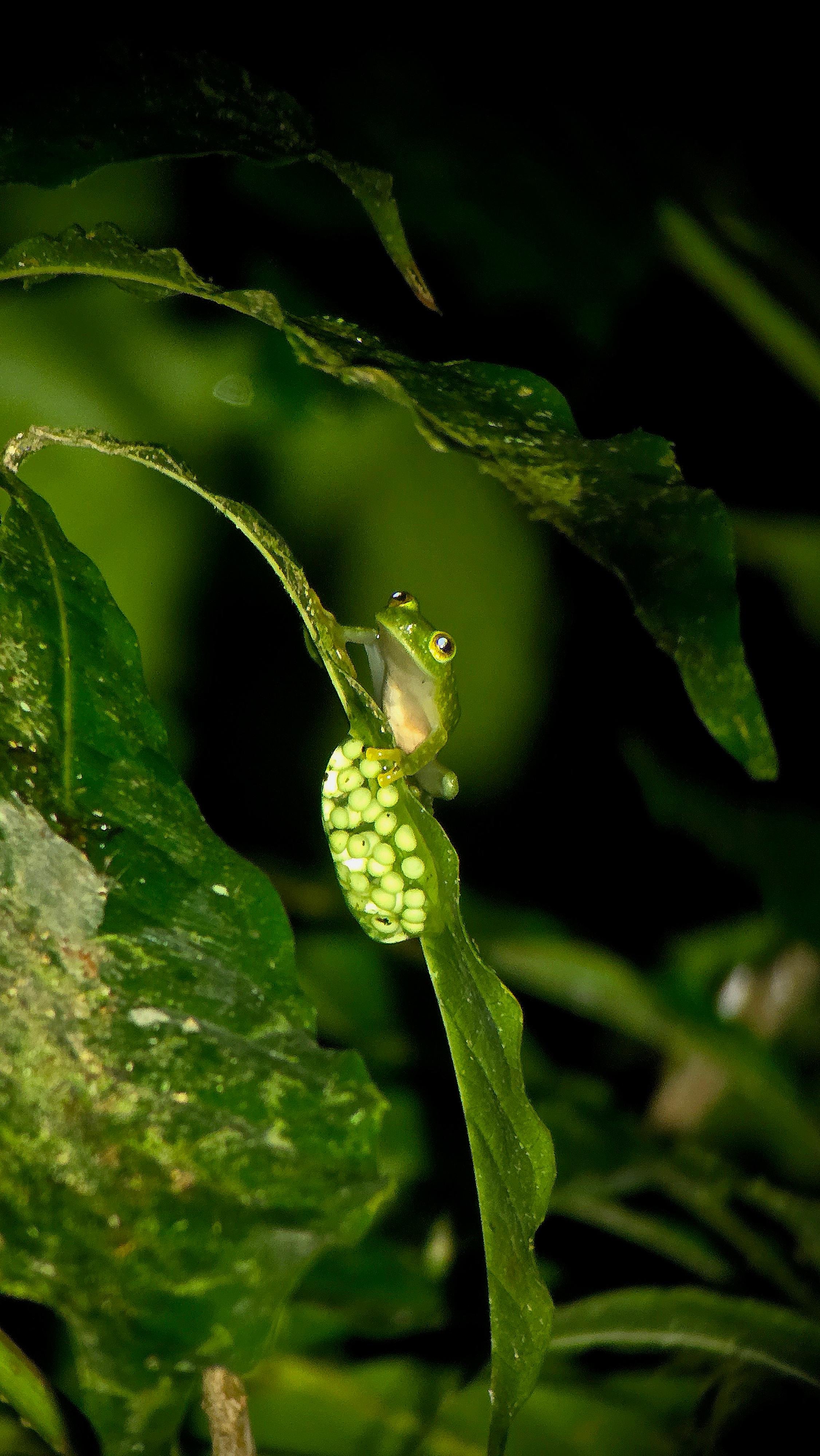
You meet your guide near Santa Elena as the last daylight drains from the sky, then travel six kilometers east toward the reserve boundary where private trails enter the montane wet forest. The walk begins under a canopy so dense that your eyes require ten minutes to adjust, even with the guide's red-filtered beam sweeping the understory. You pause at a heliconia patch where a reticulated glass frog, translucent enough to reveal its beating heart, clings to a leaf underside. The guide signals silence: twenty meters ahead, a kinkajou descends headfirst down a strangler fig, its prehensile tail coiled for balance. You continue upslope along a trail slick with moss, stepping over exposed roots as thick as your forearm. The guide stops again, this time directing your gaze to a low branch where an eyelash viper — yellow phase — rests motionless, waiting for a careless mouse. Farther on, you encounter a two-toed sloth moving between trees, its nocturnal activity contradicting the daytime lethargy most visitors assume defines the species. The air smells of wet earth and decomposing leaves, the humidity so thick it coats your camera lens. Near the trail's highest point, the guide extinguishes all lights. You stand in absolute darkness, listening: the metallic trill of a clay-colored robin, the rustle of an agouti in the leaf litter, the distant bark of a howler monkey settling for the night. When the lights return, you spot an orange-kneed tarantula the size of your palm crossing the path, unhurried and methodical. You descend slowly, cataloging sixteen species by the time you return to the trailhead two hours after you began.
The reserve is open daily from 07:00–16:00 for daytime access, though specialized night tours occur after dark.
Yes, booking in advance is essential to secure your spot for a monteverde cloud forest reserve night tour.
The terrain is uneven and steep, making it challenging for those with limited mobility to join a night tour.
No, flash photography is strictly prohibited during the monteverde cloud forest reserve night tour to protect animal behavior.
The dry season from November to February often provides clearer conditions for your nocturnal forest experience.
Consumption of food is not permitted on the trails to preserve the ecosystem during your monteverde cloud forest reserve night tour.
Visitors typically take a shuttle or taxi from Santa Elena to reach the entrance for their monteverde cloud forest reserve night tour.
Children are allowed, provided they can remain quiet during the monteverde cloud forest reserve night tour tour.
Please check the specific terms provided at the time of purchase for your monteverde cloud forest reserve night tour.
Nearby areas like the Butterfly Garden are great to combine with your visit to the Monteverde Cloud Forest Reserve.